

Curious about lemon laws? Read our Lemon Law FAQ page
2023-2026 GM Brake System Failure Investigation
Class Action Investigation
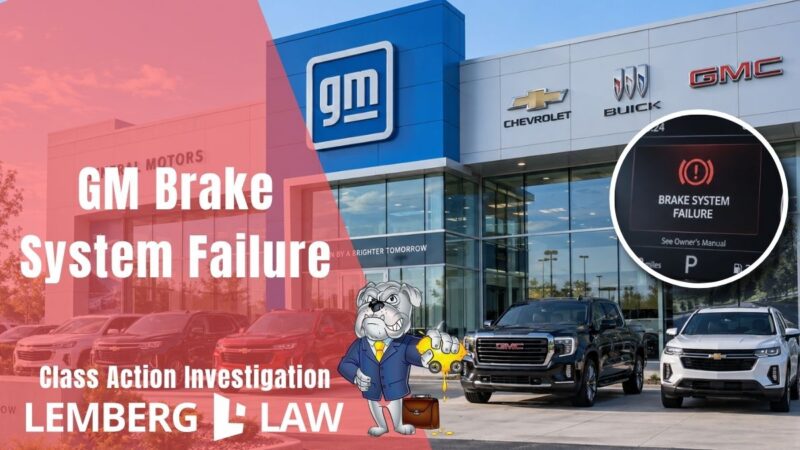
Lemberg Law is launching a class action investigation into a brake system failure defect affecting millions of vehicles manufactured by General Motors and sold under multiple brands. The defect causes a sudden and complete loss of brake assist while driving, making it extremely difficult or impossible to stop the vehicle. NHTSA has opened a formal Engineering Analysis into this issue.
I’m Sergei Lemberg, a consumer protection attorney who has spent more than two decades representing vehicle owners in lemon law and defect cases. Part of my practice involves tracking federal safety investigations. This one is serious. We are talking about a braking system failure across more than one million vehicles, 22 crashes, and 6 injuries already on record.
So I pulled the complaints. Same failure, described the same way, across vehicle after vehicle and brand after brand. I’ve included my research and source material below
What’s the Problem with the GM eBoost Braking System?
These vehicles are equipped with a Gen 2 eBoost braking system, which uses an electronic brake control module to provide power brake assist. When the system fails, brake assist is lost suddenly and without adequate warning, making the vehicle extremely difficult or impossible to stop.
NHTSA has identified two failure patterns. The first involves a spindle fracture that causes loss of brake assist after the vehicle comes to a complete stop. The second, and more concerning, involves an immediate loss of brake assist during active braking.
Owners report the same symptoms:
- Sudden loss of brake assist while driving
- Brake pedal becomes extremely hard to press or goes to the floor
- Multiple simultaneous warning lights and messages on the dashboard
- Vehicle speed electronically limited to 43 or 62 mph
- Loss of ABS, traction control, and stability control
- Failure occurs at low mileage, sometimes within days of purchase
- Issue recurs after dealer repairs and software updates
- Dealers unable to replicate or permanently resolve the failure
Which Vehicles Are Involved?
Based on NHTSA’s Engineering Analysis EA26006 and owner complaints, this investigation currently focuses on the following vehicles equipped with the Gen 2 eBoost braking system:
- Acura ZDX (2024-2026)
- Buick Enclave (2024-2026)
- Buick Envision (2024-2026)
- Cadillac Celestiq (2025-2026)
- Cadillac Lyriq (2023-2026)
- Cadillac Optiq (2025-2026)
- Chevrolet Blazer EV (2024-2026)
- Chevrolet Colorado (2023-2026)
- Chevrolet Equinox EV (2024-2026)
- Chevrolet Traverse (2024-2026)
- GMC Acadia (2024-2026)
- GMC Canyon (2023-2026)
- Honda Prologue (2024-2026)
What are Owners Experiencing?
Here are a few complaints I found in my research that highlight this issue:
“While driving my 2024 Chevrolet Blazer EV, the vehicle suffered a sudden, complete failure of the power braking assist system. The failure was accompanied by a rapid cascade of three sequential dashboard warning messages in immediate succession: First Warning: Service ESC illuminated alongside the Brake Park warning light. Second Warning: Brake Assist Failure. Press Hard to Brake. Speed Limited illuminated with Brake Park remaining on. Third Warning: Brake System Failure. 62 MPH Top Speed illuminated with Brake Park remaining on. Immediately upon these warnings triggering, the power braking assist and emergency mechanical reserve failed completely. When pressing the brake pedal, the vehicle did not slow down, and the pedal failed to engage the brakes. To avoid a catastrophic intersection collision and bring the vehicle to a halt, I was forced to deliberately steer the vehicle into a concrete curb to use friction to stop the car. The vehicle is a total loss of braking safety and cannot be driven. Safety Risk: The sudden loss of braking assist creates an immediate crash hazard, as stopping distances are severely multiplied. Limiting a vehicle to a maximum speed of 62 mph while experiencing zero brake assist on active roadways places the driver and surrounding traffic in extreme danger.”
“When turning the vehicle on, it sometimes displays an error in the instrument panel of the “Brake system failure 43 MPH Top Speed” When this error is present, the vehicle has almost no braking capability. One pedal braking is also disabled when this happens. So the only way to stop the car is to mash the brake pedal to the floor like your life depends on it. Turning the vehicle off for 5 minutes and turning it back on seems to clear the issue.”
“There was “Brake System Failure” message on the EV’s digital display. It happened 3 times in less than a month. When it happened, I had to apply the break very hard. Otherwise, the car would not stop completely and would not hit the car in front. Top speed is limited 43 mph so I could not drive it on freeway.”
“I got in my car and received the following error messages immediately upon turning on the car: – Brake System Failure 43 MPH Max Speed – Brake Assist Failure. Press hard to brake. Speed limited. – Service Stabilitrak – Auto Hold Unavailable Driving the car was very unsafe as the brakes were extremely difficult to engage, taking my full body force to fully depress the pedal and have the brakes slowly engage. I have taken the car to my Honda Dealership, which (at this time) has been unable to replicate the issue or find a problem. This is a safety issue to have unresolved, as the brakes suddenly becoming extremely difficult to work makes the car unsafe to drive.”
Federal Investigation
On August 21, 2026, NHTSA’s Office of Defects Investigation opened Engineering Analysis EA26006 to investigate the eBoost system failure across GM vehicles and peer vehicles including the Honda Prologue and Acura ZDX. Here is a snapshot of the NHTSA investigation filing:
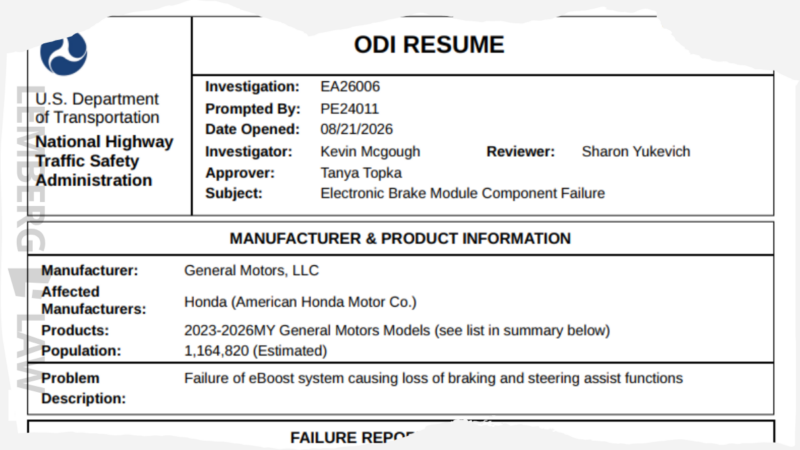
Key findings from the investigation documents:
- NHTSA has received 745 total incident reports across all affected vehicles
- 22 crashes have been reported in connection with this defect
- 6 injuries have been reported
- The estimated population of potentially affected vehicles is 1,164,820
- NHTSA has identified reports describing an immediate loss of brake assist during active braking, which it considers more dangerous than GM’s described failure mode
- Honda was separately sent an information request on September 15, 2026 regarding the Honda Prologue and Acura ZDX
The investigation remains open. NHTSA is seeking to determine the full scope of the failure and whether existing remedies are adequate.
Is There a Recall?
At this time, there is no formal safety recall covering the eBoost brake system failure across all affected vehicles.
NHTSA’s Engineering Analysis is an advanced stage of investigation that frequently precedes a recall. GM has acknowledged an internal investigation into spindle fractures in the eBoost system but has not issued a comprehensive recall. Dealers have addressed individual failures with software updates and component replacements, but multiple owners report the failure recurring after repairs.
What Can You Do?
If you own one of the affected vehicles and have experienced a sudden loss of brake assist, here are the steps to take:
- If you experience a brake system failure warning while driving, use caution and consider having the vehicle inspected by a dealer before driving it again.
- Document every incident with dates, mileage, warning messages displayed, and conditions.
- Save all repair orders and service invoices, including documentation of any repeated failures after repair.
- Ask your dealer to document the failure and open a case with the manufacturer.
- File a complaint with NHTSA at www.nhtsa.gov.
- If you are able to do so safely while the vehicle is stationary, capture video of any warning lights or failure messages on the dashboard.
Want to look up recalls? Try our Recall Lookup tool
Free Case Evaluation
If you own a Chevrolet, GMC, Buick, Cadillac, Honda, or Acura vehicle listed above and have experienced a sudden loss of brake assist, we can help. We will evaluate whether you have a lemon law claim or may be part of our class action investigation. There is no cost and no obligation.
Our firm works on a contingency-fee basis. You do not pay legal fees unless a recovery is obtained.
If your vehicle has experienced this defect, your experience matters. It may help clarify the scope of this issue and support ongoing consumer investigations.
Sources:
- NHTSA Investigation EA26006
- 2024 Acura ZDX NHTSA Complaints
- 2025 Acura ZDX NHTSA Complaints
- 2024 Buick Enclave NHTSA Complaints
- 2025 Buick Enclave NHTSA Complaints
- 2026 Buick Enclave NHTSA Complaints
- 2024 Buick Envision NHTSA Complaints
- 2025 Buick Envision NHTSA Complaints
- 2026 Buick Envision NHTSA Complaints
- 2025 Cadillac Celestiq NHTSA Complaints
- 2026 Cadillac Celestiq NHTSA Complaints
- 2023 Cadillac Lyriq NHTSA Complaints
- 2024 Cadillac Lyriq NHTSA Complaints
- 2025 Cadillac Lyriq NHTSA Complaints
- 2026 Cadillac Lyriq NHTSA Complaints
- 2025 Cadillac Optiq NHTSA Complaints
- 2026 Cadillac Optiq NHTSA Complaints
- 2024 Chevrolet Blazer EV NHTSA Complaints
- 2025 Chevrolet Blazer EV NHTSA Complaints
- 2026 Chevrolet Blazer EV NHTSA Complaints
- 2023 Chevrolet Colorado NHTSA Complaints
- 2024 Chevrolet Colorado NHTSA Complaints
- 2025 Chevrolet Colorado NHTSA Complaints
- 2026 Chevrolet Colorado NHTSA Complaints
- 2024 Chevrolet Equinox EV NHTSA Complaints
- 2025 Chevrolet Equinox EV NHTSA Complaints
- 2026 Chevrolet Equinox EV NHTSA Complaints
- 2024 Chevrolet Traverse NHTSA Complaints
- 2025 Chevrolet Traverse NHTSA Complaints
- 2026 Chevrolet Traverse NHTSA Complaints
- 2024 GMC Acadia NHTSA Complaints
- 2025 GMC Acadia NHTSA Complaints
- 2026 GMC Acadia NHTSA Complaints
- 2023 GMC Canyon NHTSA Complaints
- 2024 GMC Canyon NHTSA Complaints
- 2025 GMC Canyon NHTSA Complaints
- 2026 GMC Canyon NHTSA Complaints
- 2024 Honda Prologue NHTSA Complaints
- 2025 Honda Prologue NHTSA Complaints
- 2026 Honda Prologue NHTSA Complaints

About the Author:
Sergei Lemberg is an attorney focusing on consumer law, class actions related to automotive issues, and personal injury litigation. With nearly two decades of experience, his areas of practice include Lemon Law (vehicle defects), Debt Collection Harassment, TCPA (illegal robocalls and texts), Fair Credit Reporting Act, Overtime claims, Personal Injury cases, and Class Actions. He has consistently been recognized as the nation's "most active consumer attorney." In 2020, Mr. Lemberg represented Noah Duguid before the United States Supreme Court in the landmark case Duguid v. Facebook. He is also the author of "Defanging Debt Collectors," a guide that empowers consumers to fight back against debt collectors and prevail, as well as "Lemon Law 101: The Laws That Lemon Dealers Don't Want You to Know."
See more posts from Sergei Lemberg BE THE FIRST TO COMMENT