

Curious about lemon laws? Read our Lemon Law FAQ page
2025 Ford Explorer Transmission Problems: Rollaway & Power Loss
Class Action Investigation

My firm, Lemberg Law, is conducting a class action investigation into the 2025 Ford Explorer transmission after reviewing reports that some Explorer SUVs lose motive power while driving or roll after being placed in Park.
I’m Sergei Lemberg, and I’ve spent more than two decades working on consumer protection and lemon law cases. When I see the same complaint repeated across different owners, different locations, and different circumstances, it tells me something systematic is happening.
That is what led me to begin examining what is happening with certain Explorers.
What’s the Problem With the Ford Explorer Transmission?
Owner complaints consistently describe the same core problem. The 2025 Ford Explorer does not always stay in Park or respond correctly to gear selection. In multiple situations, drivers believed the vehicle was secure, only to see it begin rolling or shifting on its own. Others reported loss of power while driving.
The most common symptoms include:
- Vehicle rolling backward after being placed in Park
- Gear selector showing “Park” but transmission not fully engaging
- Front wheels rolling while rear wheels remain locked
- Gear shifter moving itself out of Park
- Temporary loss of acceleration while driving
- Vehicle failing to go into the selected gear
- Vehicle rolling and causing property damage
What Owners Are Saying
Here are a few real-world complaint examples that reflect the pattern we’re seeing with Explorer transmission problems:
“[I] Put car in park. SUV rolled back & damaged my garage door. Also damaged my trunk of SUV.”
“After the Ford recall software update, the gear shifter will turn itself out of park and either into drive or reverse. The software update was in regards to the PCM resetting itself. We took it to the Ford dealer and because they can not duplicate the problem, the truck was returned to us. It has happened to us more than once and it is very alarming. I have two children on top of other children in the neighborhood. I don’t trust this truck to stay in park even with it off at this point.”
“Parked vehicle on snowy driveway, went to back to unload personal items from liftgate, and vehicle began sliding backwards towards me. Ran to the driver’s door, got in, put on brakes, started vehicle and pulled it forward. Put it in park, and as I was exiting the vehicle, it began sliding backwards again. Rear wheels were locked. However, the front wheels were rolling. Apparently the transmission park pawl did not engage.”
What Does the 25V-239 Recall Say?
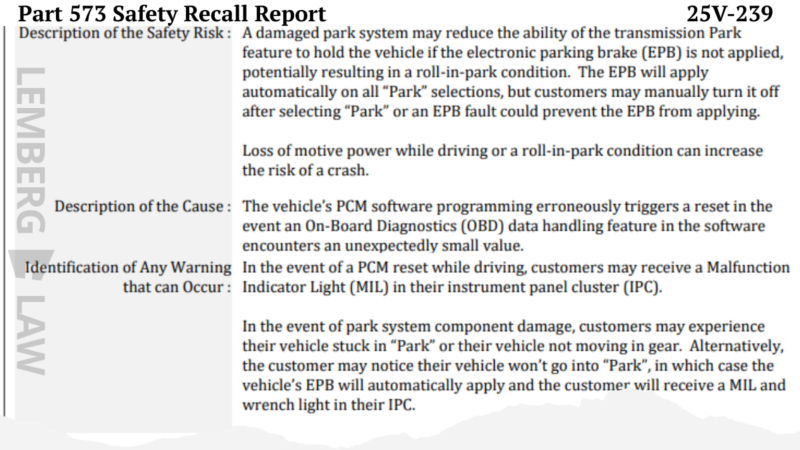
In April 2025, Ford issued safety recall 25V-239 covering 24,655 model year 2025 Explorers with 2.3-liter engines built between December 6, 2023, and September 6, 2024. The recall addresses a software programming error in the Powertrain Control Module that triggers unexpected resets.
According to Ford’s filing with NHTSA, the defect can cause:
- Park pawl to engage while the vehicle is moving, potentially damaging the park system if traveling above 10 mph
- Temporary loss of vehicle acceleration during a PCM reset
- Complete loss of motive power if eight consecutive resets occur within 18 seconds
- Roll-in-park condition if the park system is damaged and the electronic parking brake isn’t applied
- Malfunction indicator light or wrench warning light on the dashboard
Below is an excerpt from Recall 25V-239 so you can review the recall for yourself:
Where the 25V-239 Recall Leaves Owners
The recall remedy consists of:
- A PCM software update
- Inspection of the transmission park system
- Replacement of damaged components if necessary
Owner notification letters were scheduled to begin mailing in late May 2025.
However, several owners report that even after software updates, they continue to experience Explorer transmission problems like shifting or park-engagement issues.
What Can You Do If You Own One
If you own or lease a 2025 Ford Explorer, here are several steps you can take:
- Verify whether your vehicle is included in the recall. You can search by VIN at the NHTSA website.
- Schedule the recall repair promptly if your vehicle is covered.
- Document any rolling, shifting, or loss-of-power events with dates and conditions.
- Photograph or video evidence when safe to do so.
- Keep copies of all dealer repair orders.
Get a Free Case Evaluation
If you have experienced rolling in Park, loss of motive power, or shifting problems in a 2025 Ford Explorer, you may request a free case evaluation with Lemberg Law.
There is no cost to speak with us. We work on a contingency-fee basis, which means you do not pay legal fees unless there is a recovery. There is no obligation, no pressure, and no guarantees. The purpose is simply to help you understand your options.
Class action investigations are one possible path. Individual warranty, lemon law, or consumer protection claims may also be appropriate depending on the specific facts of your situation. Our role is to help owners make informed decisions as this investigation continues to develop.
Sources:

About the Author:
Sergei Lemberg is an attorney focusing on consumer law, class actions related to automotive issues, and personal injury litigation. With nearly two decades of experience, his areas of practice include Lemon Law (vehicle defects), Debt Collection Harassment, TCPA (illegal robocalls and texts), Fair Credit Reporting Act, Overtime claims, Personal Injury cases, and Class Actions. He has consistently been recognized as the nation's "most active consumer attorney." In 2020, Mr. Lemberg represented Noah Duguid before the United States Supreme Court in the landmark case Duguid v. Facebook. He is also the author of "Defanging Debt Collectors," a guide that empowers consumers to fight back against debt collectors and prevail, as well as "Lemon Law 101: The Laws That Lemon Dealers Don't Want You to Know."
See more posts from Sergei Lemberg BE THE FIRST TO COMMENT