

Curious about lemon laws? Read our Lemon Law FAQ page
Honda / Acura Auto Idle Stop System Problem: Stop Start Doesn’t Work
Class Action Investigation

Lemberg Law is launching a class action investigation into a recurring defect affecting Honda and Acura vehicles equipped with auto idle stop systems, where the engine fails to restart after coming to a complete stop.
I’m Sergei Lemberg, a consumer protection attorney who has spent more than two decades representing vehicle owners in lemon law and defect cases. What drew my attention to this issue wasn’t just the volume of complaints—it was the consistency. When you see the same failure pattern emerge across multiple model years, multiple vehicle lines, and even across two different brands under the same manufacturer, that tells you something. It suggests a systemic problem, not isolated incidents.
I reviewed hundreds of consumer complaints, manufacturer service bulletins, and federal filings to provide a complete account of this issue. I’ve included the research and source material below. Let’s get started.
What’s the Problem with Honda’s Auto Idle Stop System?
Honda and Acura introduced Auto Idle Stop to improve fuel efficiency. In theory, the system shuts the engine off at a stop and restarts it automatically when the driver lifts off the brake. In practice, many owners say the restart never happens.
Honda itself has acknowledged this behavior in internal service bulletins, describing a condition where “after coming to a stop and the idle stop feature engages, the vehicle may not automatically restart”
Despite software updates, warranty extensions, and multi-stage repair procedures, complaints have continued and expanded into newer model years.
Consumer report the same symptoms:
- Engine shuts off at a stop and will not restart
- Vehicle stalls in traffic or at intersections
- Restart requires turning the car completely off
- Rough or delayed restarts
- Dashboard warnings related to idle stop
- Battery and starter replacements that do not always solve the problem
Which Vehicles Are Involved
Based on owner complaints, federal filings, and manufacturer documentation, this investigation currently focuses on the following Honda and Acura vehicles equipped with the Auto Idle Stop system:
- Honda Pilot (2022, 2023, 2024, 2025)
- Honda Odyssey (2021, 2022, 2023, 2024, 2025)
- Honda Passport (2022, 2023, 2024, 2025)
- Honda Ridgeline (2022, 2023, 2024, 2025)
- Acura TLX (2021, 2022, 2023, 2024, 2025)
- Acura MDX (2021, 2022, 2023, 2024, 2025)
My research shows that this issue does not begin with these model years. Federal records and service documentation trace similar no-restart complaints back as early as 2015, involving earlier generations of both Honda and Acura vehicles equipped with start/stop technology.
Whare are Owners Experiencing?
The complaints we’ve gathered paint a clear picture of how this defect manifests in real-world driving. Here are a few samples:
“Idle Stop Failure. This has occurred many times. Presents itself as: Failure to restart upon releasing the brake. Rough restart. Sometimes have to completely turn off car and restart.”
“When stopped at a red light on a busy off ramp to a busy highway, the car’s engine idle function turned the engine off (as anticipated), but then upon releasing the brake, the car did not turn on. I was stalled in the middle of traffic, which is a significant safety issue. I had to turn the car completely off, wait a few seconds, and turn back on.”
“My Odyssey has a no-restart issue related to Auto Idle Stop. Engine did not restart at red light and I had to push the button twice. We were caught in traffic and were not safe.”
Auto Idle Stop Technical Service Bulletins
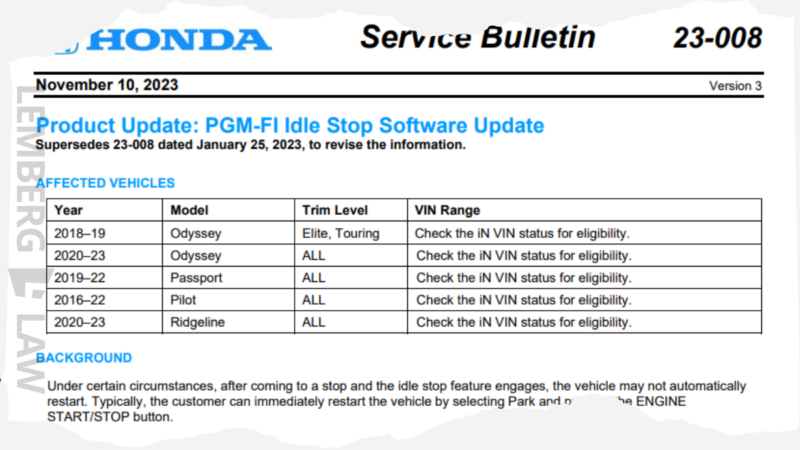
In March 2023, Honda issued service bulletins 23-008, 23-009, and 23-010, acknowledging that “under certain circumstances, after coming to a stop and the idle stop feature engages, the vehicle may not automatically restart.” The company initiated a product update campaign covering certain 2016-2022 Pilot, 2019-2022 Passport, and 2020-2023 Ridgeline models. Similar service bulletins addressed the issue in Acura TLX and MDX vehicles.
Honda’s remedy was a two-stage approach. First, dealers would update the PGM-FI (Programmed Fuel Injection) software, a process that takes approximately 15 minutes. If the software update didn’t resolve the problem, the second stage involved replacing the starter assembly and starter relays, and adjusting the engine valves, a repair that could take up to three hours. Honda also extended warranty coverage for these repairs to 10 years from the original purchase date with no mileage limitation.
Here’s a look at TSB 23-008 from November 2023:
Federal Investigation
On March 26, 2025, the National Highway Traffic Safety Administration (NHTSA) opened a formal Engineering Analysis (EA25004) to investigate the defect. NHTSA summarized the issue plainly:
“The complaints allege that the engine fails to restart on its own from a complete stop at a traffic light or road intersection with the Auto Start/Stop function engaged.”
According to the investigation resume, NHTSA has received 1,348 complaints about the auto idle stop failure, including reports of four crashes and two injuries. The investigation scope encompasses approximately 2.2 million vehicles across Honda and Acura model lines from 2015 through 2025.
The federal investigation specifically notes that many complainants reported the failure persisting even after Honda’s service campaign repairs were completed.
Take a look at this screencap of the NHTSA’s Engineering Analysis, EA25004:

Is There a Recall?
At this time, there is no formal safety recall covering the Auto Idle Stop no-restart defect in Honda and Acura vehicles.
Honda has instead addressed the issue through service bulletins, software updates, and warranty extensions. These programs acknowledge the problem, but they are not classified as recalls, and they rely on dealership diagnosis and owner awareness.
What Can You Do
If you own one of these vehicles and have experienced this issue, here are a few steps you can take:
- Document every incident with dates, mileage, and conditions.
- Save all repair orders and service invoices.
- Ask the dealer whether software update campaigns were applied.
- File a complaint with NHTSA.
Legal Rights
Warranty law, lemon law, and consumer protection statutes may apply when a defect affects safety, drivability, or value — especially if repairs fail or the defect persists after multiple attempts. These laws exist to protect consumers when manufacturers cannot fully correct systemic problems.
Every case is different, and no outcome is guaranteed. But owners deserve clear information and honest evaluation.
Get a Free Case Evaluation
If you’ve experienced auto idle stop restart failures in your Honda or Acura, we can review your situation at no cost and with no obligation. We will evaluate whether you may have a potential individual lemon law claim or whether your experience may be relevant to the broader class action investigation we are conducting into this defect.
Our firm works on a contingency-fee basis, meaning you do not pay legal fees unless a recovery is obtained. There is no pressure and no guarantees, only an opportunity to understand your options.
If your vehicle has failed to restart after an auto idle stop event, your experience may help clarify the scope of this issue and support ongoing consumer investigations.
Sources:
- 2021 Honda Pilot Complaints
- 2025 Honda Odyssey Complaints
- 2021 Honda Passport Complaints
- 2021 Honda Ridgeline Complaints
- 2025 Acura MDX Complaints
- Honda TSB 23-008 (November 2023)
- NHTSA ODI Resume EA22005

About the Author:
Sergei Lemberg is an attorney focusing on consumer law, class actions related to automotive issues, and personal injury litigation. With nearly two decades of experience, his areas of practice include Lemon Law (vehicle defects), Debt Collection Harassment, TCPA (illegal robocalls and texts), Fair Credit Reporting Act, Overtime claims, Personal Injury cases, and Class Actions. He has consistently been recognized as the nation's "most active consumer attorney." In 2020, Mr. Lemberg represented Noah Duguid before the United States Supreme Court in the landmark case Duguid v. Facebook. He is also the author of "Defanging Debt Collectors," a guide that empowers consumers to fight back against debt collectors and prevail, as well as "Lemon Law 101: The Laws That Lemon Dealers Don't Want You to Know."
See more posts from Sergei Lemberg BE THE FIRST TO COMMENT