

Curious about lemon laws? Read our Lemon Law FAQ page
2023–2025 Ford F-150 Rear Axle Bolt Problem & Recall: Here’s What I Found
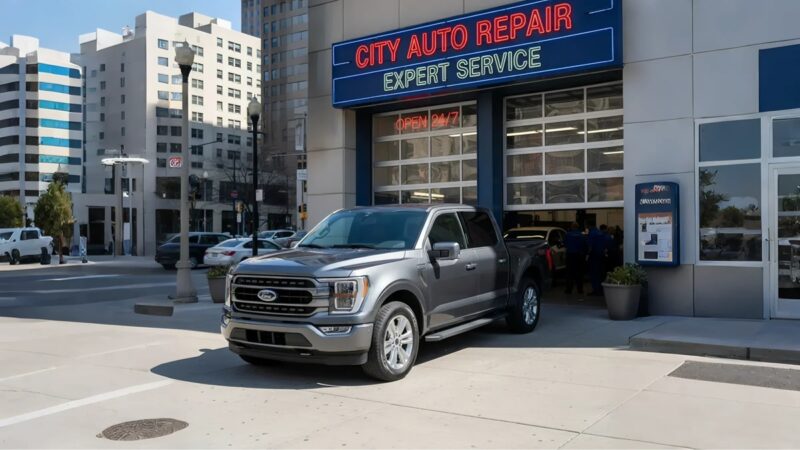
A rear axle bolt recall for the 2025 F-150? That sounds awfully familiar.
As a lemon lawyer, I pay close attention to recalls. It’s not unusual for me to spend hours reviewing recall notices for new vehicles, looking for patterns. When I came across the August 2025 recall for the F-150 regarding a rear axle hub bolt issue, something clicked. I’d seen this before.
Sure enough, Ford has been dealing with this same rear axle problem since 2021.
But here’s what makes this interesting: Ford still doesn’t have enough parts to fix all these trucks. Some owners have been waiting over a year for repairs. Others have been told by their dealers not to drive their vehicles because they’re unsafe, yet Ford hasn’t provided loaners or firm timelines for when parts will arrive. Meanwhile, these owners are making monthly payments on trucks they can’t use.
This is what I found when I started digging into the details.
Hundreds of Axle Bolt Complaints
The issue first surfaced in 2021-2023 Ford F-150 trucks equipped with the Trailer Tow Max Duty package and a 9.75-inch heavy duty axle with a three-quarter float axle design. By 2023, Ford expanded the affected population to include 2023-2025 model year trucks.
The root cause is a rear axle hub bolt that can break due to fatigue. Here’s how the failure progresses:
- The bolt is designed to prevent micro-movement between the hub splines and the axle shaft splines
- When the bolt breaks, that micro-movement begins
- In corrosive environments such as road salt, moisture, and normal driving conditions, the movement causes wear.
- Metal particles get displaced from the splines, then corrode and expand
- The corroded particles accelerate the wearing down of the hub splines themselves
- Eventually, the hub splines strip out completely
When those splines fail, two dangerous scenarios can occur: the truck can roll away even when parked in gear, or it can lose drive power entirely while on the road. Ford acknowledges both scenarios increase crash risk.
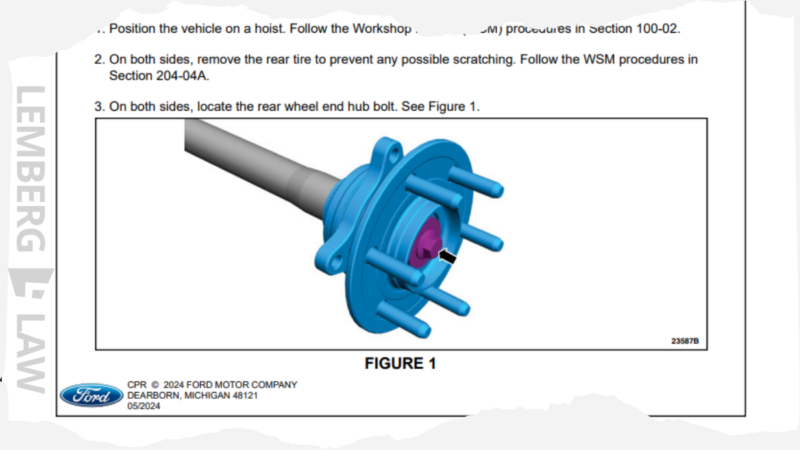
Take a look at this diagram showing where the bolt is located in the hub:
What Owners Are Experiencing
The early warning signs often sound minor, but they signal a likely serious mechanical failure in progress:
- Clicking noise from the rear axle when driving, particularly noticeable at lower speeds or during acceleration
- Rattling sound from the wheel cap area, often discovered during routine maintenance like oil changes or tire rotations
- Violent jerking or hesitation when pressing the accelerator, especially at highway speeds
- Sudden loss of drive power in two-wheel drive mode, forcing drivers to engage four-wheel drive to continue moving
- Vehicle rollaway incidents when parked on an incline without the parking brake engaged
- Complete rear axle failure requiring both left and right axle shaft assemblies to be replaced
- Warning lights including “Service Now” and “Service Rear Differential” messages appearing even after repair attempts
Owner Complaint Examples
Here’s what actual F-150 owners reported to the National Highway Traffic Safety Administration:
“I purchased this vehicle from Ford about 2 months ago and brought it in for service over 4 weeks ago. The service department inspected the hub bolts and declared the vehicle unsafe to drive until the recall is completed due to sheered bolts. Although the recall says the parts are available, that is apparently not accurate.”
“The rear axle hub bolt was found to be broken off, same as the other recalled vehicles from this manufacturer. I have been waiting over 2 1/2 weeks for my vehicle to be repaired with no parts in stock yet and no loaner vehicle.”
“I attempted to schedule the fix for this recall and Ford is saying they will not fix unless the axel bolt has already failed. I read the recall notice as Ford will fix the axel regardless if is has failed or not.”
The Recall Timeline: From 2023 to 2025
Ford’s handling of this rear axle defect spans multiple years and several safety campaigns:
July 2023 – Customer Satisfaction Program 22B34
Ford initiated a voluntary service campaign for certain 2021-2022 F-150 vehicles with the 9.75-inch HD axle. This wasn’t yet a formal safety recall.
January 2024 – Safety Recall 23S65 (NHTSA 23V896)
Ford escalated to a formal safety recall covering approximately 113,066 vehicles: 2021-2023 F-150 trucks built between January 2020 and December 2022. The remedy was to replace both rear axle half-shaft and hub assemblies.
The problem: parts weren’t available. Ford told dealers they could only repair trucks with active complaints of loose or broken hub bolts. Everyone else would have to wait.
May 2024 – Parts Delay Announced
Ford updated dealers that parts wouldn’t be available until first quarter 2025—nearly a year out from the original recall.
August 2025 – Expanded Recall 25S82 (NHTSA 25V512)
Ford issued a new recall covering 103,174 additional vehicles: 2023-2025 F-150 trucks built between January 2, 2023, and May 21, 2025. Ford’s investigation had revealed the problem extended beyond the original recall population, with 194 warranty claims on newer trucks built after the first recall’s cutoff date.
Owner notification letters began mailing August 18, 2025, continuing through May 22, 2026. But parts availability remained a critical issue—Ford’s dealer bulletin stated parts were available only in “limited quantities” requiring special approval before ordering.
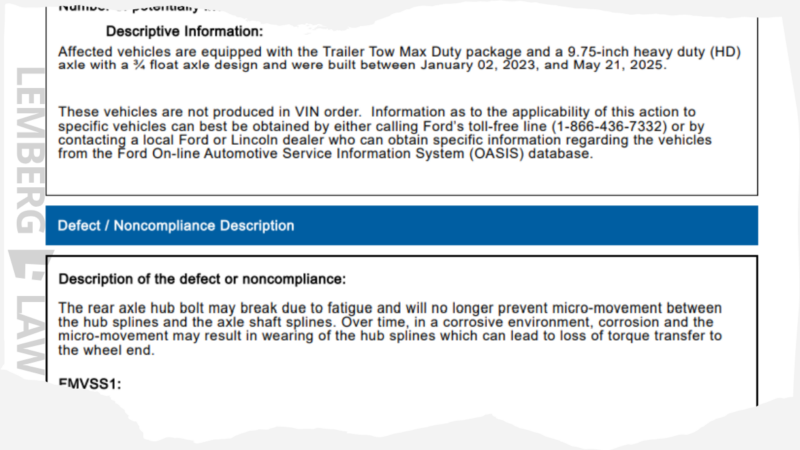
Below is an excerpt from Recall 25V512 so you can review the recall language for yourself:
What You Can Do If You Own an Affected F-150
If you own a 2023-2025 Ford F-150 with the Trailer Tow Max Duty package, here’s what you can do:
Check if your truck is included in the recall: You can search by VIN at NHTSA’s website or call Ford’s customer service line at 1-866-436-7332. Reference recall number 25S82 or NHTSA campaign number 25V512 or 23V896.
Document everything: If you’re experiencing clicking, rattling, jerking, or any loss of drive power, document the date, time, mileage, and specific symptoms. Take video if possible. Keep all service records, even for routine maintenance where a technician might have noted unusual noises.
Get the recall repair completed as soon as parts are available: Contact your dealer to get on their list. Make it clear you want to be notified immediately when parts arrive.
Keep records of all financial impacts: If the recall has prevented you from using your truck for its intended purpose—particularly if you bought it for towing and now can’t use it—document those losses. Keep track of RV or trailer storage fees, repair costs, alternative transportation costs, and any other expenses directly related to the issue.
If your truck has required multiple repair attempts for the same issue, or if it has been out of service for extended periods, you may have rights under your state’s lemon law. These vary by state, but most require the manufacturer to repurchase or replace vehicles with substantial defects that can’t be repaired after a reasonable number of attempts.
Contact Lemberg Law
If you’ve been affected by the Ford F-150 rear axle bolt recall and you’re facing extended delays, repeated repair failures, or significant financial losses, you may have options under federal warranty law or your state’s lemon law.
My firm represents consumers in these cases on a contingency fee basis. That means you don’t pay attorney fees unless we recover money for you. Our fees come from what we recover from the manufacturer—not from your pocket.
We’ve handled hundreds of cases involving vehicles with persistent defects, failed recalls, and manufacturers who couldn’t or wouldn’t make adequate repairs in reasonable timeframes.
To learn whether you qualify, contact Lemberg Law for a free, confidential case evaluation. There is no cost to speak with us, and no obligation to move forward.
Sources:
- 2023 NHTSA Complaints
- 2024 NHTSA Complaints
- 2025 NHTSA Complaints
- Recall No. 25V512 Letter
- Recall No. 25V512

About the Author:
Sergei Lemberg is an attorney focusing on consumer law, class actions related to automotive issues, and personal injury litigation. With nearly two decades of experience, his areas of practice include Lemon Law (vehicle defects), Debt Collection Harassment, TCPA (illegal robocalls and texts), Fair Credit Reporting Act, Overtime claims, Personal Injury cases, and Class Actions. He has consistently been recognized as the nation's "most active consumer attorney." In 2020, Mr. Lemberg represented Noah Duguid before the United States Supreme Court in the landmark case Duguid v. Facebook. He is also the author of "Defanging Debt Collectors," a guide that empowers consumers to fight back against debt collectors and prevail, as well as "Lemon Law 101: The Laws That Lemon Dealers Don't Want You to Know."
See more posts from Sergei Lemberg BE THE FIRST TO COMMENT